School of Information Science and Technology
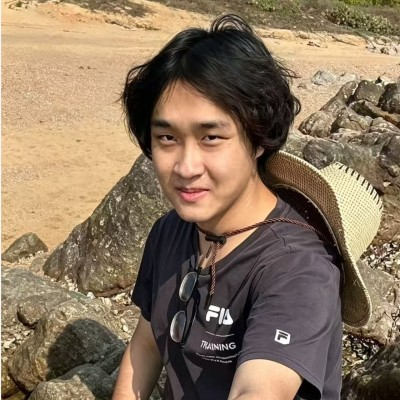
I am a member of the Robot Integration Laboratory, Faculty of Information Science and Technology, Beijing University of Technology. In the early stage of my undergraduate studies, my research focused on the applications of foundation models such as large language models and vision-language models. Later, I oriented my research toward embodied intelligence. Under the supervision of Lei Zhang, I work on robot dexterous manipulation, and under the guidance of Tongtong Feng, I conduct research on the generalization of human motion. These constitute my two primary research areas.
Furthermore, I am applying for graduate positions. Please feel free to contact me if you are interested in potential collaboration.
Interests: Robotics, HCI, Computer Vision, Multimodal Learning.
Warning
Problem: The current name of your GitHub Pages repository ("Solution: Please consider renaming the repository to "
http://".
However, if the current repository name is intended, you can ignore this message by removing "{% include widgets/debug_repo_name.html %}" in index.html.
Action required
Problem: The current root path of this site is "baseurl ("_config.yml.
Solution: Please set the
baseurl in _config.yml to "Experience
-
 University of HamburgResearch Intern Collaboration in Robot ManipulationSep. 2025 - Mar. 2026
-
 Tsinghua UniversityResearch Intern Collaboration in World Model and Reinforcement LearningApr. 2025 - Aug. 2025
-
 Beijing University of TechnologyB.S. in EnginneeringSep. 2023 - Jul. 2027
Honors & Awards
-
Mathematical Contest/Interdisciplinary Contest in Modeling Honorable Mention2026
-
The 1st World Humanoid Robot Games Group 1st2025
-
China Robot Competition and RoboCup China Open China 2nd2025
-
China University Intelligent Robot Creativity Competition China 2nd2025
-
China Intelligent Robot Fighting and Gymnastics Competition China 1st2024
News
Services
- ICCV 2025 Reviewer
- ACM MM 2025 Reviewer
- AAAI 2026 Reviewer
- IROS 2026 Reviewer
- AAAI 2027 Reviewer
- ICASSP 2027 Reviewer
Selected Publications (view all )
ActAtlas: Learning Adaptive Execution Atlases for Long-Horizon Robot Manipulation Robotics
Haidong Huang*, Yutong Shen*, Heng Zhang, Xingwei Chen, Haiyue Zhu, Jun Ma, Ding Zhao, Xiaocong Li (* equal contribution)
SubmissionUnder review. 2027
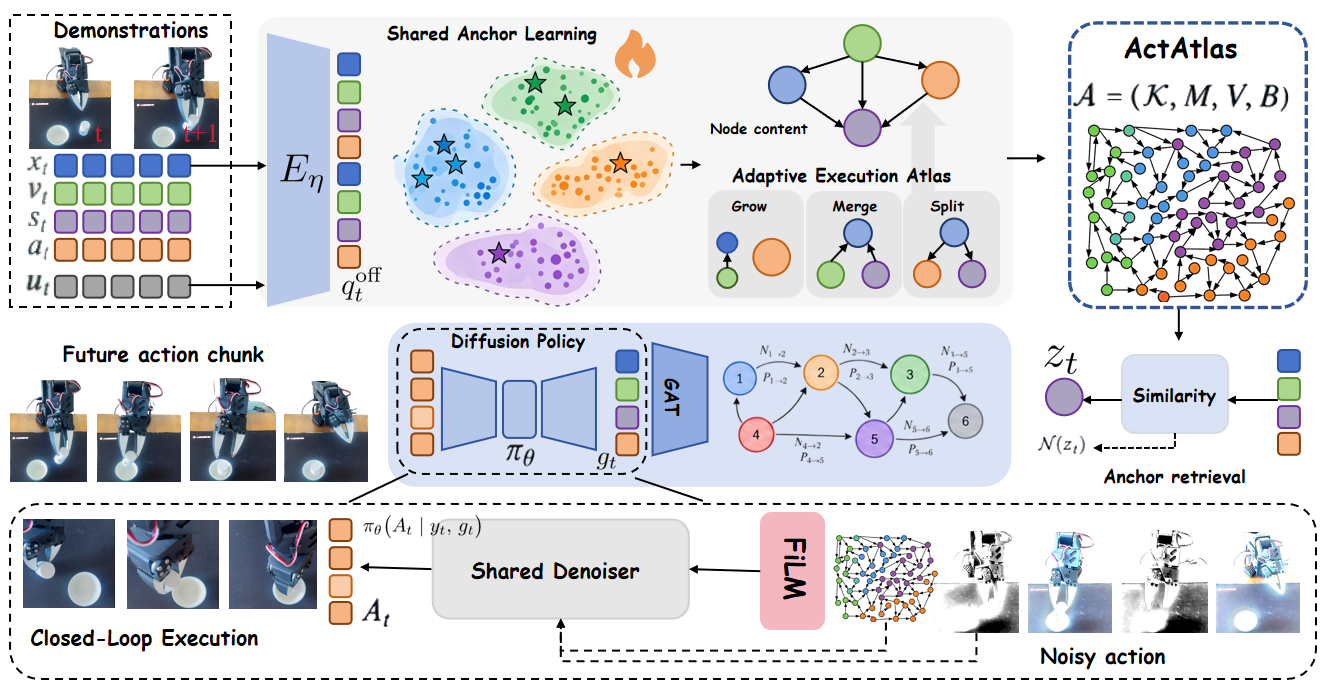
We proposes an imitation‑learning framework that obtains adaptive execution anchors via self‑supervised learning to construct an execution‑flow graph, and conditions a diffusion policy with this graph to address the challenge where locally similar states demand distinct actions under different contexts in long‑horizon robotic manipulation tasks, achieving superior performance across multiple simulation benchmarks.
ActAtlas: Learning Adaptive Execution Atlases for Long-Horizon Robot Manipulation Robotics
Haidong Huang*, Yutong Shen*, Heng Zhang, Xingwei Chen, Haiyue Zhu, Jun Ma, Ding Zhao, Xiaocong Li (* equal contribution)
SubmissionUnder review. 2027
We proposes an imitation‑learning framework that obtains adaptive execution anchors via self‑supervised learning to construct an execution‑flow graph, and conditions a diffusion policy with this graph to address the challenge where locally similar states demand distinct actions under different contexts in long‑horizon robotic manipulation tasks, achieving superior performance across multiple simulation benchmarks.
Consequence-Quotient Flow Matching for Robot Manipulation Robotics
Yutong Shen*, Haidong Huang*, Haoxuan Xu, Heng Zhang, Yiqing Yin, Lei Zhang, Xiaocong Li (* equal contribution)
SubmissionUnder review. 2027
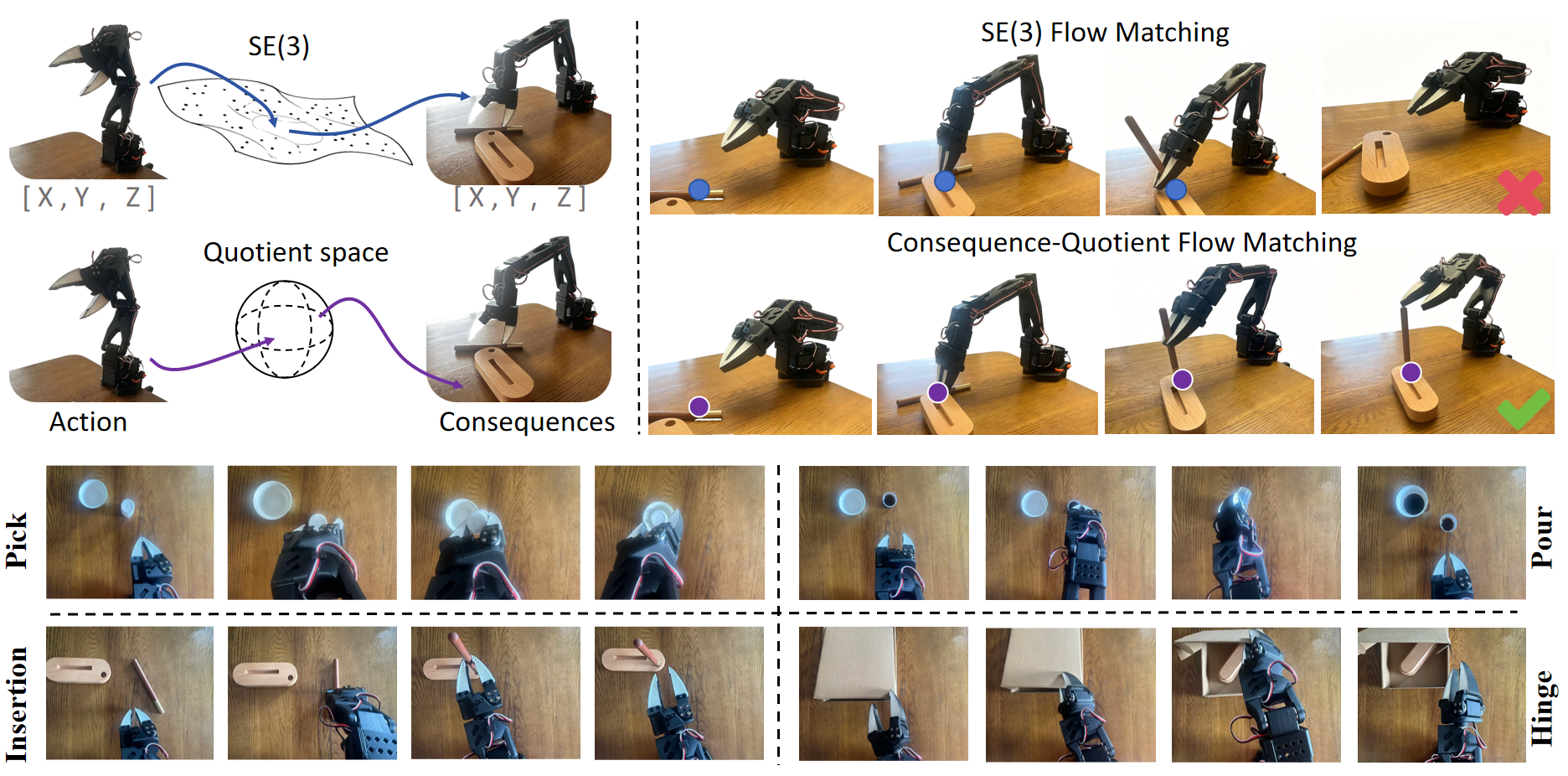
We propose CQ‑FM, which constructs a consequence‑quotient space based on task outcomes, pulls back the consequence‑aware metric into the action space via Jacobians, reshapes the Flow‑Matching loss during training and enables closed‑loop correction at inference to improve the task success rate and contact stability of vision‑language‑action robot manipulation policies.
Consequence-Quotient Flow Matching for Robot Manipulation Robotics
Yutong Shen*, Haidong Huang*, Haoxuan Xu, Heng Zhang, Yiqing Yin, Lei Zhang, Xiaocong Li (* equal contribution)
SubmissionUnder review. 2027
We propose CQ‑FM, which constructs a consequence‑quotient space based on task outcomes, pulls back the consequence‑aware metric into the action space via Jacobians, reshapes the Flow‑Matching loss during training and enables closed‑loop correction at inference to improve the task success rate and contact stability of vision‑language‑action robot manipulation policies.
MetaWorld-X: Hierarchical World Modeling via Semantic-Prior Orchestrated Experts for Humanoid Loco-Manipulation Robotics
Yutong Shen*, Haidong Huang*, Heng Zhang, Penghui Liu, Jiashuo Luo, Shunqi Zhang, Chen Jiang, Chenguang Yang, Arash Ajoudani, Jianwei Zhang, Lei Zhang (* equal contribution)
Under ReviewUnder review. 2027
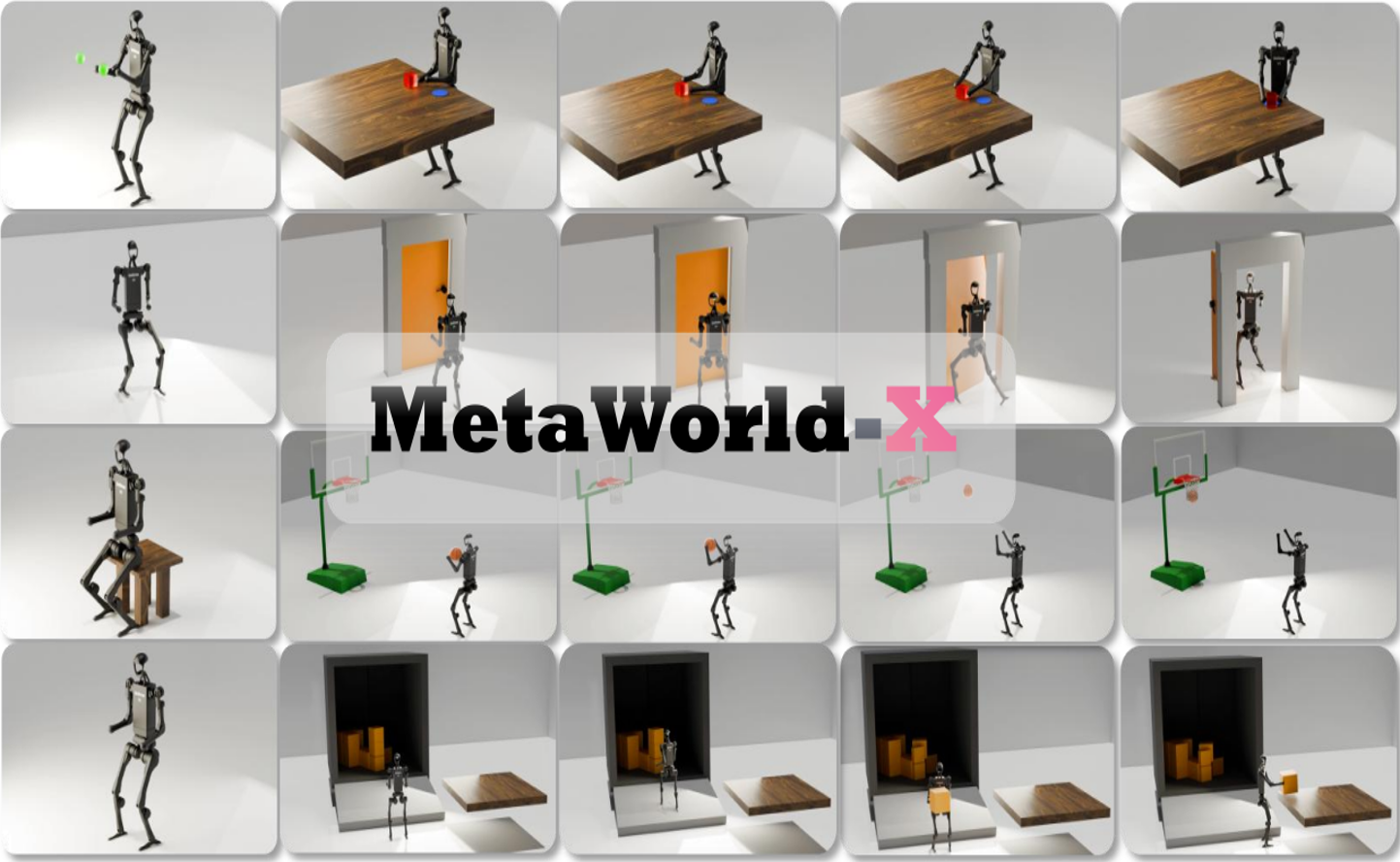
We propose a whole-body control framework for humanoid robots that mitigates cross-skill interference in high-DoF systems via Specialized Expert Policies (SEP), a VLM-supervised Intelligent Routing Mechanism (IRM), and latent dynamics model-based training-time optimization, achieving significant return improvements and faster convergence on HumanoidBench.
MetaWorld-X: Hierarchical World Modeling via Semantic-Prior Orchestrated Experts for Humanoid Loco-Manipulation Robotics
Yutong Shen*, Haidong Huang*, Heng Zhang, Penghui Liu, Jiashuo Luo, Shunqi Zhang, Chen Jiang, Chenguang Yang, Arash Ajoudani, Jianwei Zhang, Lei Zhang (* equal contribution)
Under ReviewUnder review. 2027
We propose a whole-body control framework for humanoid robots that mitigates cross-skill interference in high-DoF systems via Specialized Expert Policies (SEP), a VLM-supervised Intelligent Routing Mechanism (IRM), and latent dynamics model-based training-time optimization, achieving significant return improvements and faster convergence on HumanoidBench.
ALAS: Adaptive Long-Horizon Action Synthesis via Disentangled Environment and Self-State Representations Robotics
Yutong Shen*, Haidong Huang*, Lei Zhang, Penghui Liu, Yinqi Liu, Tongtong Feng (* equal contribution)
Under ReviewUnder review. 2027
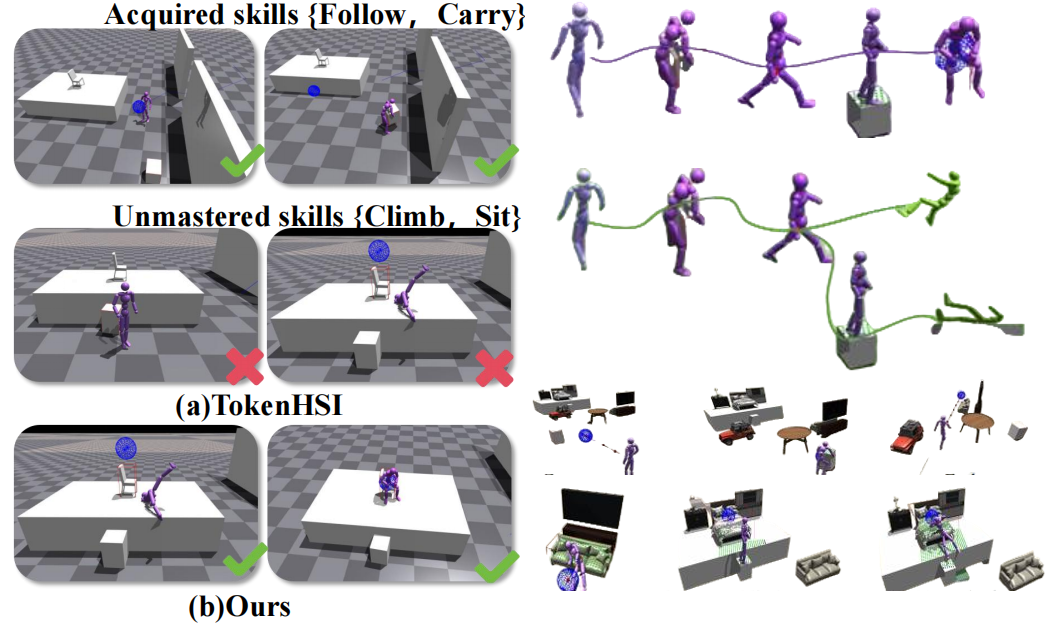
This paper proposes a biologically inspired dual-stream disentangled framework decoupling environmental scene representations and robot self-state motor encodings, equipped with three adaptive feature fusion strategies and a staged progressive training pipeline, which achieves remarkable cross-environment and cross-skill generalization for long-horizon human-scene interaction tasks and outperforms existing state-of-the-art methods on self-designed benchmarks and HumanoidBench with higher subtask success rates and execution efficiency.
ALAS: Adaptive Long-Horizon Action Synthesis via Disentangled Environment and Self-State Representations Robotics
Yutong Shen*, Haidong Huang*, Lei Zhang, Penghui Liu, Yinqi Liu, Tongtong Feng (* equal contribution)
Under ReviewUnder review. 2027
This paper proposes a biologically inspired dual-stream disentangled framework decoupling environmental scene representations and robot self-state motor encodings, equipped with three adaptive feature fusion strategies and a staged progressive training pipeline, which achieves remarkable cross-environment and cross-skill generalization for long-horizon human-scene interaction tasks and outperforms existing state-of-the-art methods on self-designed benchmarks and HumanoidBench with higher subtask success rates and execution efficiency.
GeoPreserve: Condition-Preserving 3D Diffusion Policies for Contact-Sensitive Long-Horizon Manipulation Robotics
Haidong Huang*, Yutong Shen*, Xingwei Chen, Heng Zhang, Chenguang Yang, Haiyue Zhu, Jun Ma, Xiaocong Li (* equal contribution)
Under ReviewUnder review. 2027
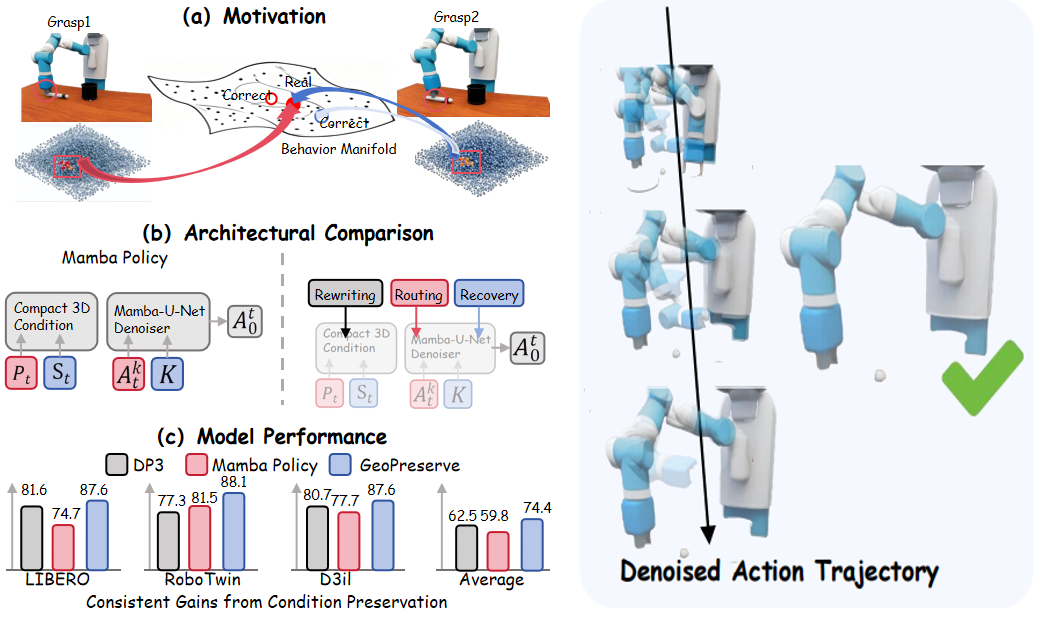
This paper proposes a condition-preserving 3D diffusion robotic manipulation policy built on a three-stage Rewriting-Routing-Recovery pipeline, which addresses the issue of critical discriminative geometric information being lost during the compression of 3D observations in contact-sensitive long-horizon tasks, achieving consistent performance gains across multiple robotic manipulation benchmarks with only a tiny increase in model parameters.
GeoPreserve: Condition-Preserving 3D Diffusion Policies for Contact-Sensitive Long-Horizon Manipulation Robotics
Haidong Huang*, Yutong Shen*, Xingwei Chen, Heng Zhang, Chenguang Yang, Haiyue Zhu, Jun Ma, Xiaocong Li (* equal contribution)
Under ReviewUnder review. 2027
This paper proposes a condition-preserving 3D diffusion robotic manipulation policy built on a three-stage Rewriting-Routing-Recovery pipeline, which addresses the issue of critical discriminative geometric information being lost during the compression of 3D observations in contact-sensitive long-horizon tasks, achieving consistent performance gains across multiple robotic manipulation benchmarks with only a tiny increase in model parameters.